

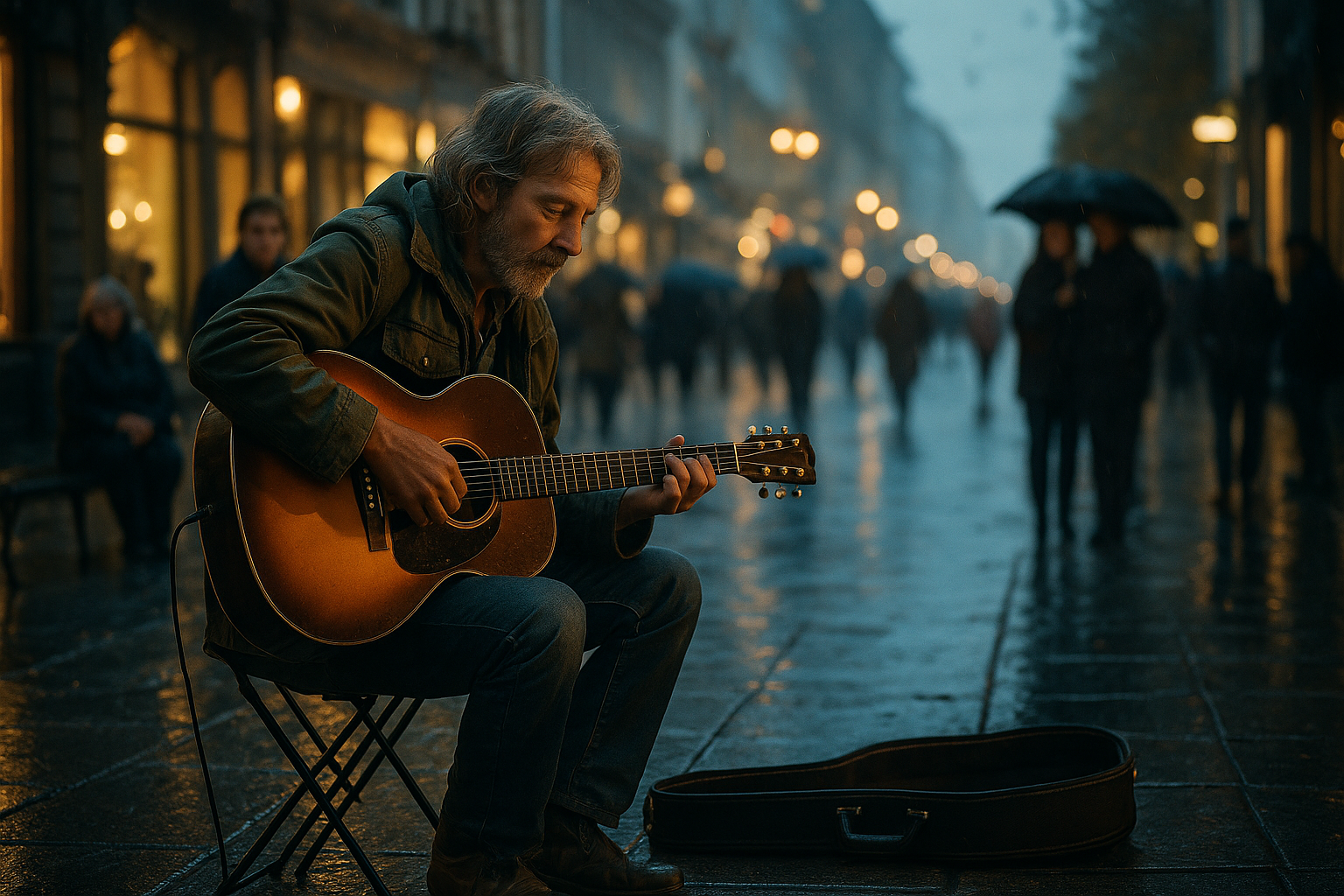
No one knew where he came from.
One week, the corner by the old train station was empty except for pigeons and a trash bin with a broken wheel.
The next week, he was there.
A man with a worn guitar case, a foldable stool, and fingers that looked like they had made peace with silence long before they found sound again.
He never asked for money.
He never held a sign.
He didn’t even look up much.
But when he played, people stopped.
Not because he was loud.
Because he wasn’t.
His name, people eventually learned, was Julian.
Not because he announced it, but because someone heard him tell a little girl after she’d stood in front of him for ten minutes straight, not blinking.
“What’s your name?” she’d asked.
“Julian,” he’d replied, like it was a word he only used when absolutely necessary.
The girl nodded seriously.
“I’m going to remember that,” she said.
He smiled softly.
“Don’t,” he teased. “Just remember how this feels.”
His music didn’t follow patterns.
No setlist.
No known songs.
Just melodies that felt… uncannily specific.
Not universally pretty.
Personally precise.
The kind that slid straight past your ears and into your memory.
The first time Elena heard him, she almost missed it.
She’d been power-walking, phone pressed to her ear, arguing with someone who wasn’t really listening.
“I said I’ll get it done by Friday— no, I’m not changing the whole thing again—”
Then she froze.
Right in the middle of the sidewalk.
Her voice fell out of her mouth.
Because his guitar had just said something to her that words hadn’t managed in years.
A slow, quiet tune.
Soft chords. Broken rhythm.
And suddenly—
She was seven years old again, on her father’s shoulders at a county fair, laughter in her throat, cotton candy sticky on her fingers, the world impossibly wide and kind.
Her chest tightened.
“What is that song?” she whispered.
Julian didn’t look at her.
He just kept playing.
And when the song ended, the memory faded back into the present like a dream rolling up its sleeves and going back to work.
She stayed anyway.
Soon, it was never just one person.
There was always someone.
A businessman whose eyes softened mid-stride.
A teenager who suddenly blinked fast like he’d been caught crying by his own childhood.
An old woman on a bench who hummed along to a tune she swore she’d never heard.
Everyone heard something different.
Not different music.
Different meaning.
Different moments.
Different doors opening inward.
Marcus first heard him after his latest job interview rejection.
He’d been walking with his hands shoved into his jacket, rehearsing disappointments like a speech.
Not good enough.
Too late.
Why would they choose me?
Then Julian started playing.
Low notes.
Slow.
Persistent.
And all Marcus could see was himself at nineteen, standing on a rooftop with his best friend, wind howling, laughing like nothing could ever outgrow them.
The feeling.
Not the memory.
The feeling of believing.
In himself.
In possibility.
In time not being his enemy.
Marcus sat on the curb, stunned.
When the song ended, he stayed.
Not for the next one.
For himself.
People began planning their walks around that corner.
Not admitting it, of course.
They’d say things like:
“Oh, it’s just on my way.”
“I like the coffee nearby.”
“It’s busy there, easier to blend in.”
But they all knew.
They were coming to hear themselves again.
Not the versions they performed for meetings or families or social media.
The old, private versions.
The ones that had existed before disappointment learned their names.
A little boy once asked him, “How do you know what to play?”
Julian paused.
The silence felt intentional.
“Because I’m not playing for your ears,” he said gently.
“I’m playing for where you keep the things you thought you’d lost.”
The boy frowned.
“I didn’t lose anything,” he said.
Julian smiled.
“Exactly,” he murmured.
Weeks turned into months.
Seasons shifted.
Sleeves lengthened.
Scarves appeared.
Still, Julian came.
Same corner.
Same stool.
Same quiet patience.
People came to expect him.
To depend on him.
But he never belonged to them.
He just gave them moments back.
Then one morning, he didn’t show up.
No one panicked.
Not immediately.
They figured he was sick.
Or tired.
Or just a person.
They moved on with their days.
But the corner felt… wrong.
Like a music box missing a gear.
He didn’t come the next day.
Or the next.
People still slowed down when passing the spot.
Their steps hesitated.
As if the air still remembered his sound.
As if the stones themselves were slightly warmer where he used to sit.
But he was gone.
Until one evening.
Rain had just finished.
The city smelled like wet pavement and something new underneath it.
Someone started playing.
But not him.
A young woman.
Nervous fingers.
Cheap guitar.
Shaky breath.
She played softly.
Not perfectly.
But with something raw and unafraid.
A tune.
Familiar without being known.
And people slowed again.
Not because it was as good.
But because it was honest.
Someone whispered,
“It’s not the same.”
Someone else said,
“No… but it’s the consequence.”
Elena recognized the melody.
Marcus did too.
So did the old woman from the bench.
Not as a song.
But as a feeling.
The feeling of beginning again.
Julian never came back.
But he didn’t disappear.
Because every time someone stood on that corner with trembling hands and chose to create instead of close up…
Every time someone felt something they had buried and decided not to hide from it…
Every time a person remembered themselves and let it matter…
That music was still playing.
Just through different hands.